
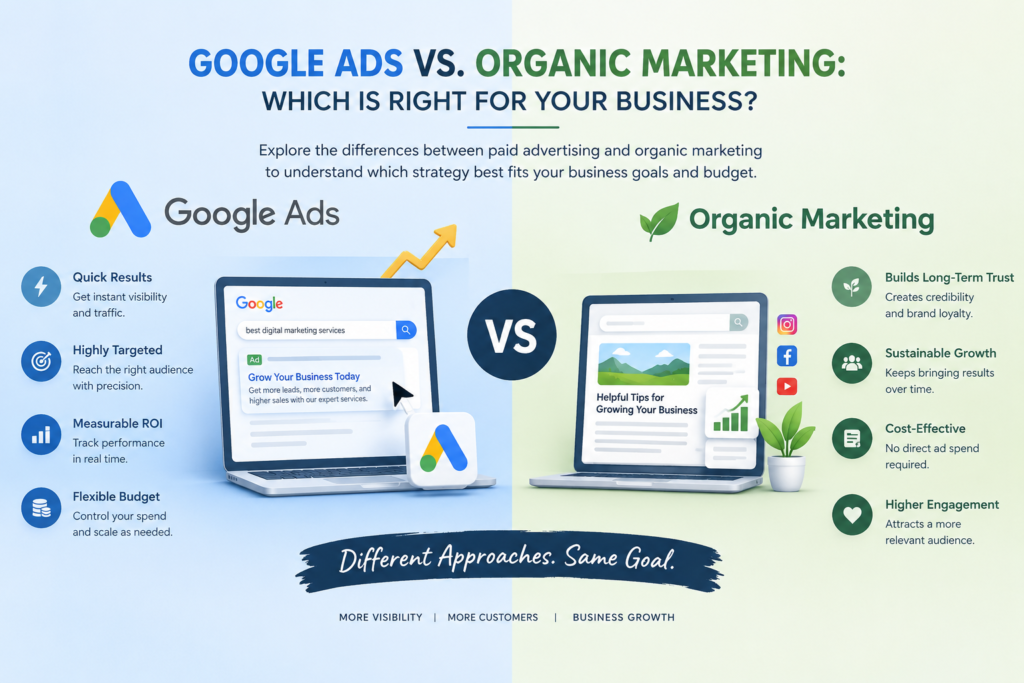
GOOGLE ADS VS. ORGANIC MARKETING: WHICH IS RIGHT FOR YOUR BUSINESS?
Choosing the right digital marketing strategy is essential for business growth. Today, businesses use different online marketing methods to reach potential customers, increase brand awareness, and generate leads. Two popular approaches are Google Ads and organic marketing. Both help businesses connect with their target audience, but they work in different ways.
Google Ads focuses on paid advertising to reach potential customers quickly, while organic marketing focuses on building visibility and trust through valuable content, search engine optimization (SEO), and social media engagement. Understanding the differences between these strategies can help businesses choose the right approach based on their goals, budget, and long-term plans.
What Is Google Ads?
Google Ads is an online advertising platform that allows businesses to display paid advertisements on Google Search and other platforms within Google’s advertising network. Businesses can create ads that appear when users search for specific keywords related to their products or services.
For example, if someone searches for “best digital marketing services,” a business running Google Ads may appear at the top of the search results with a sponsored label. This helps businesses reach people who are actively looking for particular products or services.
Google Ads generally operates through an auction system. Advertisers select relevant keywords, create advertisements, set budgets, and compete for ad placements. Depending on the campaign type, businesses may pay for clicks, impressions, or other measurable actions.
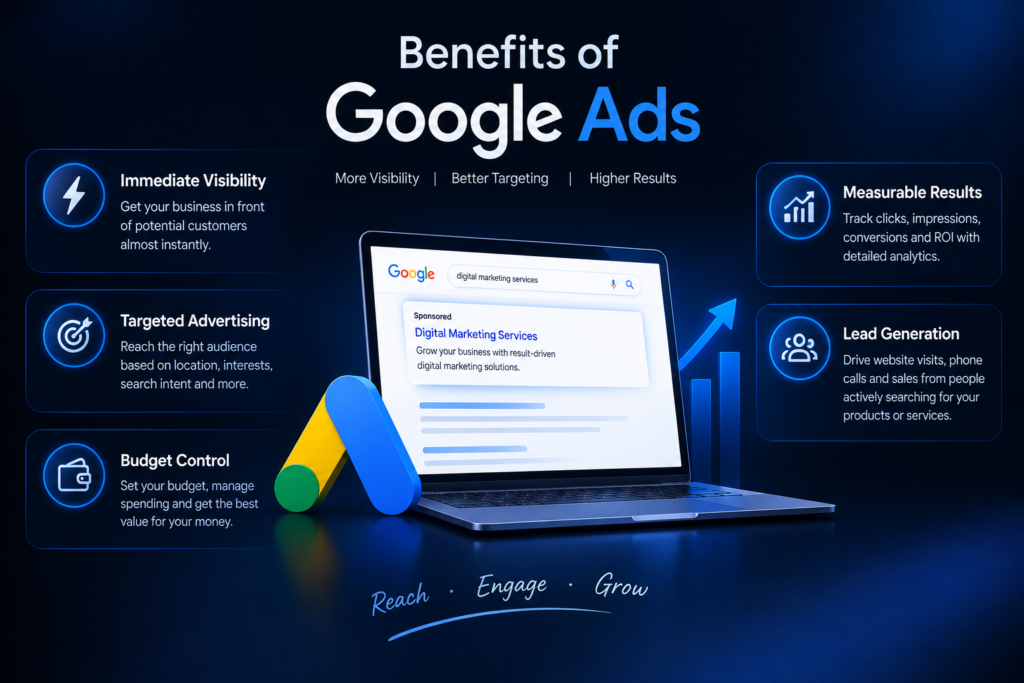
Benefits of Google Ads.
1. Immediate Visibility.
Google Ads can help businesses gain visibility shortly after a campaign becomes eligible to run. Unlike SEO, which often requires time to produce results, paid advertising can bring potential customers to a website much faster.
2. Targeted Advertising.
Businesses can target audiences using factors such as location, search queries, language, interests, and other available campaign settings. This helps advertisers reach people who are more likely to be interested in their offerings.
3. Budget Control.
Google Ads allows businesses to set campaign budgets and manage their advertising expenses. Advertisers can monitor spending and adjust their campaigns according to performance.
4. Measurable Results.
Businesses can track metrics such as clicks, impressions, conversions, and cost per conversion. These insights help marketers understand campaign performance and identify opportunities for improvement.
5. Lead Generation.
Google Ads can help businesses generate enquiries, website visits, phone calls, and sales by reaching users who are actively searching for relevant solutions.
Limitations of Google Ads
Despite its advantages, Google Ads has some limitations. Businesses must pay to maintain advertising traffic, and costs can increase when competition for keywords is high. Poor targeting, weak landing pages, and ineffective advertisements can waste the budget.
Additionally, paid advertisements do not guarantee sales or conversions. Successful campaigns require proper keyword research, compelling ad copy, effective landing pages, and continuous optimization.
What Is Organic Marketing?
Organic marketing is the process of attracting and engaging an audience without directly paying for each advertisement or click. It focuses on building a strong online presence through valuable content, search engine optimization, social media activity, and meaningful audience relationships.
For example, a business that publishes helpful blog articles, optimizes its website for relevant search terms, and shares informative social media posts can attract potential customers organically.
Search engine optimization is an important part of organic marketing. It helps improve a website’s relevance, accessibility, and visibility in unpaid search results. Organic marketing can also include social media posts, educational videos, email content, and community engagement.
Benefits of Organic Marketing.
1. Long-Term Visibility
Organic marketing can help businesses build a sustainable online presence. A well-optimized website or useful blog post may continue attracting visitors long after it is published, although rankings and traffic can change over time.
2. Builds Trust and Credibility
People often appreciate businesses that provide useful information and answer their questions. Consistently sharing helpful content can strengthen credibility and encourage potential customers to explore a brand.
3. Cost-Effective Growth
Organic marketing does not require payment for every click. However, it still involves costs related to content creation, SEO tools, website maintenance, staff time, and marketing expertise.
4. Better Audience Engagement
Social media content, informative articles, and educational videos help businesses communicate with their audiences. Meaningful interactions can build stronger relationships and encourage repeat engagement.
5. Supports Brand Awareness
Regularly publishing useful and relevant content helps businesses become more recognizable within their industry. Over time, this can contribute to brand authority and customer loyalty.
Limitations of Organic Marketing?
Organic marketing usually takes time to produce meaningful results. SEO improvements may take months, depending on competition, website quality, and the effectiveness of the strategy. Social media reach can also fluctuate because of changing algorithms and audience behavior.
Furthermore, organic visibility is not guaranteed. Businesses must consistently publish relevant content, maintain their websites, analyze performance, and adapt to changing customer needs.
Google Ads vs. Organic Marketing: Key Differences.
Although both strategies aim to attract potential customers, their approaches differ in several important ways.
| Factor | Google Ads | Organic Marketing |
|---|---|---|
| Cost | Requires an advertising budget | No payment per click, but resources are needed |
| Speed | Can generate visibility quickly | Usually takes time to build visibility |
| Traffic | Depends on paid campaign delivery | Can continue without paying for each visit |
| Trust | Clearly labeled as sponsored advertising | Can build credibility through helpful content |
| Targeting | Offers specific advertising targeting options | Reaches audiences through relevance and engagement |
| Sustainability | Traffic generally declines when ads stop | Content may continue attracting visitors over time |
| Measurement | Detailed campaign and conversion tracking | SEO, website, and engagement analytics |
| Best suited for | Quick visibility and targeted campaigns | Long-term visibility and audience relationships |
The most suitable option depends on the business’s objectives, available resources, competitive environment, and expected timeline.
Which Strategy Is Better for Your Business?
There is no single answer that works for every business. The right strategy depends on what you want to achieve and how quickly you need results.
Choose Google Ads If:
- You want to generate leads or sales quickly.
- You are launching a new product or service.
- You need to promote a time-sensitive offer.
- You have a defined advertising budget.
- You want to test customer demand for specific products or services.
For example, a newly launched online store may use Google Ads to reach customers searching for its products while testing which keywords and offers generate sales.
Choose Organic Marketing If:
- You want to build long-term online visibility.
- You want to improve unpaid search rankings.
- You want to establish trust and credibility.
- You can consistently create useful content.
- You want to develop an audience and strengthen your brand over time.
For example, a digital marketing agency can publish SEO guides, educational blog posts, and social media content to attract people searching for marketing solutions.
Can You Use Google Ads and Organic Marketing Together?
Yes. For many businesses, combining Google Ads with organic marketing can be more effective than relying on only one strategy.
Google Ads can help generate immediate visibility while organic marketing builds long-term value. Both strategies can also provide useful insights into customer behavior and search demand.
For instance, a business can use Google Ads to identify keywords that generate enquiries and then create relevant website pages or blog articles targeting those search topics organically. Meanwhile, SEO can help attract visitors without requiring payment for every click.
A combined strategy may include:
- Running Google Ads campaigns for high-intent keywords.
- Optimizing website pages through SEO.
- Publishing informative blog posts that answer customer questions.
- Sharing valuable content on social media platforms.
- Tracking conversions and adjusting marketing activities based on performance.
Businesses should evaluate both approaches regularly and allocate resources according to their results. Paid advertising can support immediate objectives, while organic marketing can contribute to sustainable growth.
How to Measure Success
Measuring performance is essential for understanding whether your marketing strategy is working.
For Google Ads, important metrics include click-through rate, cost per click, conversion rate, cost per conversion, and return on ad spend. These measurements help businesses understand how effectively their advertising budget generates meaningful results.
For organic marketing, businesses can monitor organic website traffic, keyword rankings, search impressions, click-through rates, engagement, leads, and conversions. Tools such as Google Analytics and Google Search Console can help evaluate website and search performance.
Rather than focusing only on traffic, businesses should measure outcomes that support their objectives. For example, a service-based business may prioritize qualified enquiries, while an online store may focus on purchases and revenue.
Conclusion
Google Ads and organic marketing are both valuable digital marketing strategies, but they serve different purposes. Google Ads can help businesses gain visibility quickly, reach targeted audiences, and generate leads through paid campaigns. Organic marketing focuses on building lasting visibility, trust, and audience relationships through SEO, content creation, and consistent engagement.
If your business needs faster results and has an advertising budget, Google Ads may be a suitable starting point. If your goal is to develop long-term visibility and establish credibility, organic marketing is worth investing in. For many businesses, combining both approaches provides a balanced strategy for achieving immediate goals while building a stronger online presence over time.
Ultimately, the best digital marketing strategy is the one that aligns with your business goals, understands your audience, and delivers measurable results. By continuously analyzing performance and improving your approach, you can make informed marketing decisions and create opportunities for sustainable business growth.